What this is
The project tracks how Japanese rope practices moved from historical restraint systems and twentieth-century publishing into contemporary international scenes. It is not a directory of everyone who ties rope. It is a curated dataset of people, schools, studios, dojos, bars, venues, events, publications, films and context entries with enough public evidence to explain a historical or structural role.
The old working name was Bakushi Map. The public umbrella is now Shibari Atlas; the lineage section is now called Bakushi Lineage.
Three surfaces
One research base, three readings. Each surface answers a different question; entries and sources are shared.
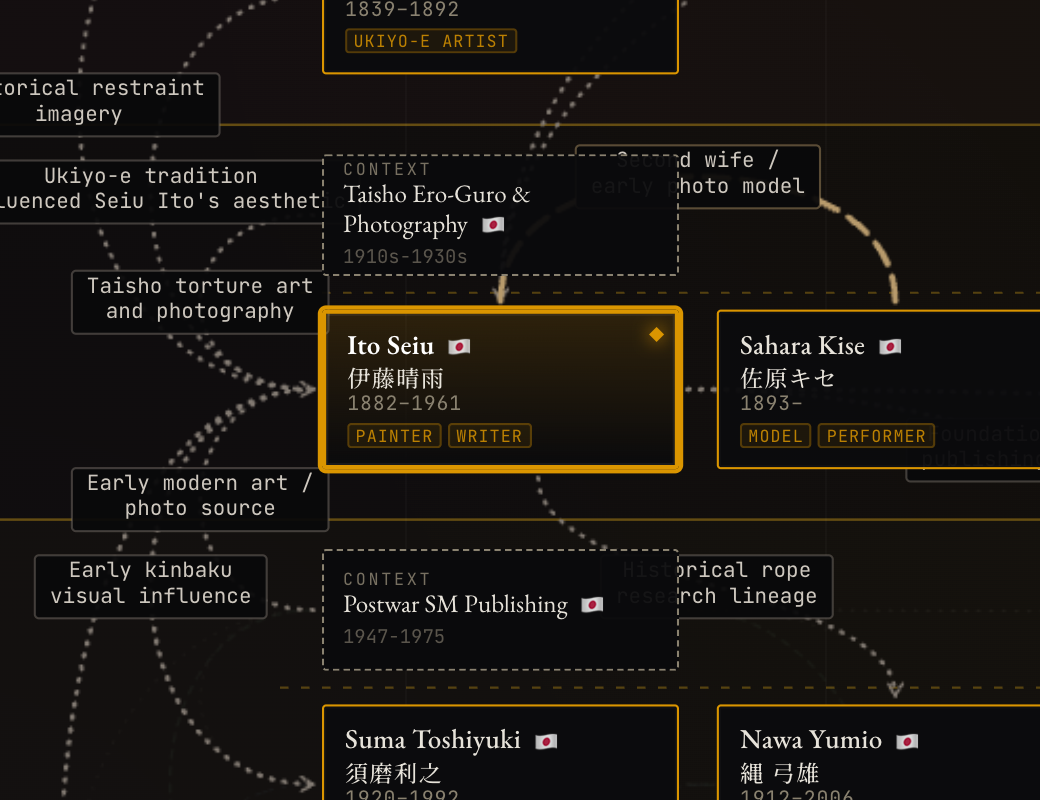
3,772 documented connections
Time-based genealogy view. Vertical position is time, columns group practitioners by school, and documented relationships show teaching, collaboration and publication ties.
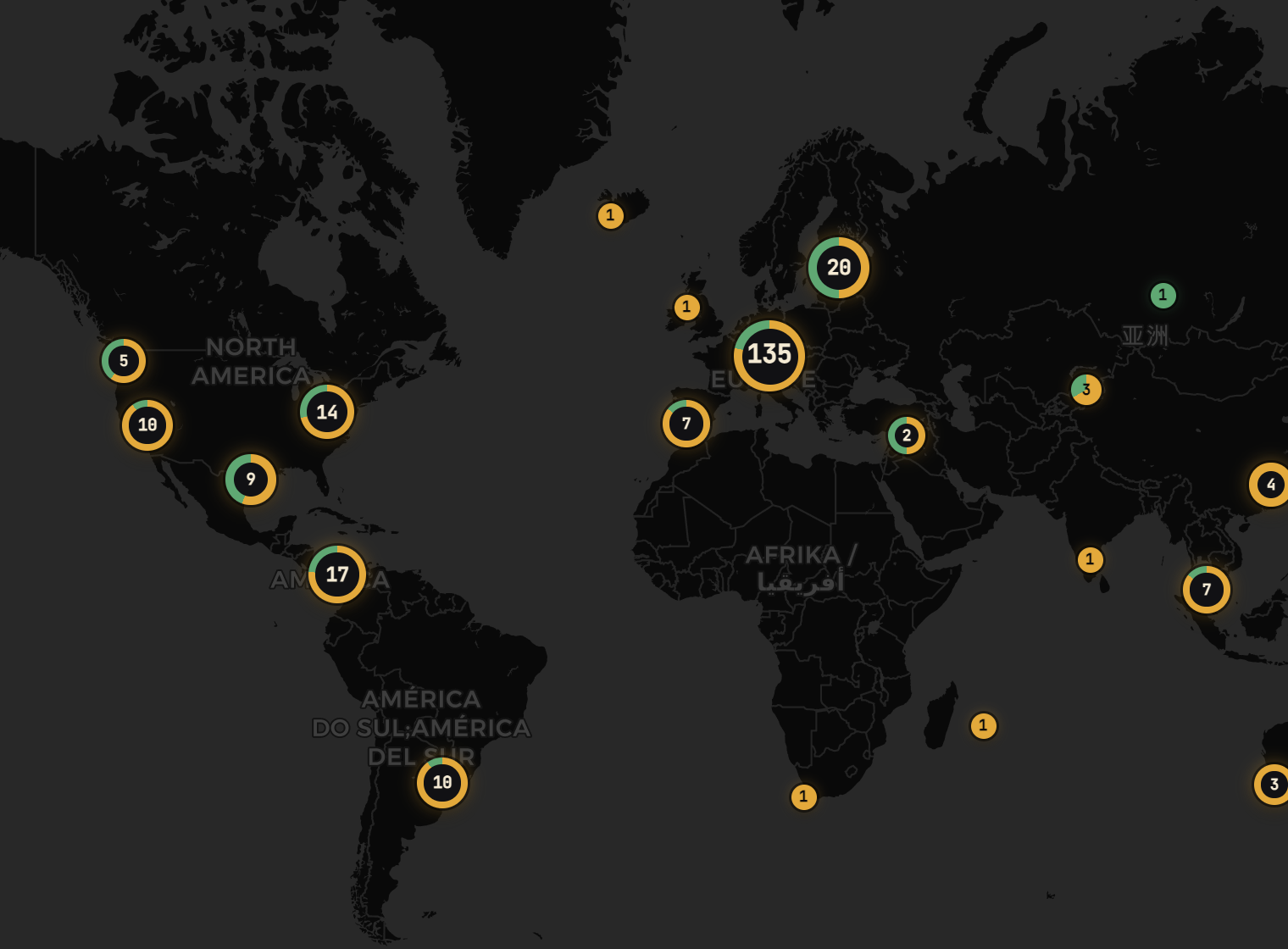
69 countries · 312 cities
1440 located entries pinned to where they actually exist or happened: studios, dojos, bars, venues, events and resident practitioners on a navigable world map.
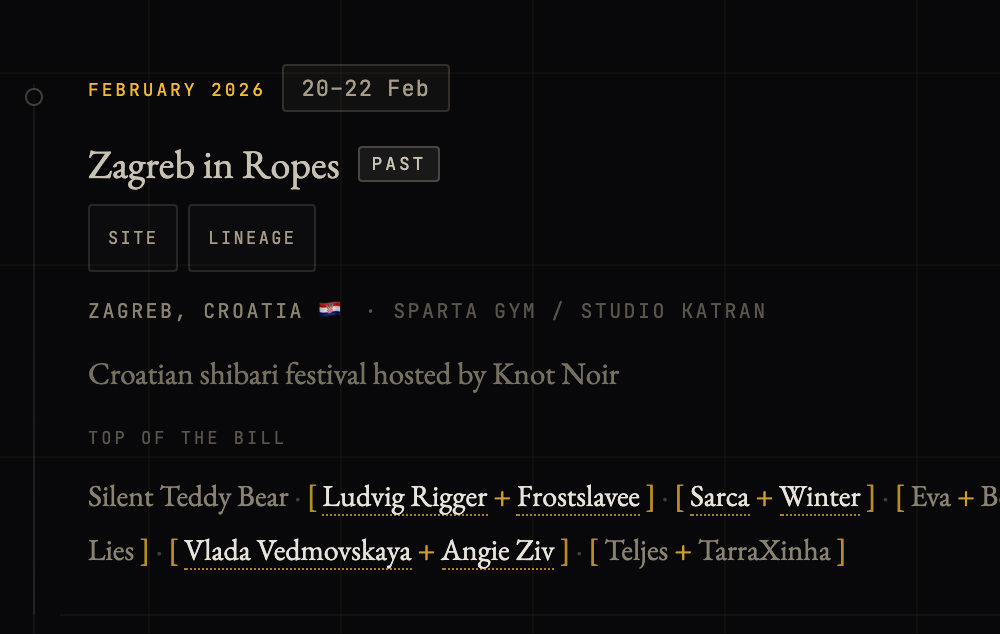
Two calendar-year schedules
Calendar-year schedules for festivals and gatherings, plus studio workshops and classes.
Beta status
Shibari Atlas is in public beta. The interface is live and usable today, but the dataset behind it is still being expanded and corrected. Read it as a working draft that is actively maintained — not a finished or exhaustive reference.
- What already works
- All three surfaces are functional, and every entry is anchored to public sources. The historical core — from the early pioneers to the major twentieth-century lineages — is the most thoroughly documented part of the dataset.
- What is still moving
- Coverage is uneven. Some regions and many contemporary scenes are far thinner than the historical record. Entries are added in batches, and relationships are revised as stronger sources surface. A gap is expected; an absence is not a verdict.
- Deliberate gaps
- Missing birth years are intentional when a practitioner has not published them, and legal names are avoided unless already part of someone's chosen public profile. These omissions are policy, not oversight.
- How you can help
- Corrections, missing sources and boundary questions go to pussynawa@proton.me. The full editorial standard lives on the methodology page; the evidence list is at sources.
Data & licensing
Structured facts are released under CC0 where legally possible: IDs, names, public aliases, years, locations, entry categories and relationship categories. Original project prose is licensed under CC BY-SA 4.0.
Third-party sources remain under their own rights. Source links support verification and attribution; they do not import linked text into this project's license.
Frequently asked
New here? Start with the terms, then the project specifics. The editorial detail behind these answers lives on the methodology page.
What is bakushi?
Bakushi (縛師, lit. “tying master”) is the Japanese term for a rope artist — a practitioner of kinbaku. The word denotes a person; the practice itself is kinbaku or shibari. Traditionally the title was reserved for established rope masters working professionally in twentieth-century Japan; outside Japan it is used more loosely.
What is kinbaku?
Kinbaku (緊縛, lit. “tight binding”) is the Japanese art of erotic rope bondage. It descends from hojōjutsu, the Edo-period martial art of restraining prisoners with rope, and was reshaped through twentieth-century SM magazines, photography and performance into the form practised today.
What is the difference between shibari and kinbaku?
The two are often used interchangeably and the line between them is contested. In broad practice: shibari (縛り) literally means “tying” and is commonly used outside Japan as an umbrella term; kinbaku (緊縛) carries a stronger sense of the erotic, ritual and emotional tradition rooted in twentieth-century Japan.
What is the difference between bondage, shibari and kinbaku?
Bondage is the general Western BDSM term for consensual restraint by any means — rope, cuffs, tape, chains — with no tie to Japan or to rope specifically. Shibari and kinbaku (see above) are Japanese rope-specific terms, and usage genuinely splits: some treat them as a subset of bondage, some use all three interchangeably, and some reserve kinbaku for a fuller ritual/erotic practice against shibari as bare technique. A smaller strand of practitioners also questions non-Japanese use of the Japanese terms at all. None of these usages is settled — the atlas does not take a side.
What is hojōjutsu?
Hojōjutsu (捕縄術) is the Edo-period martial art of arresting and restraining prisoners with rope, developed for samurai and feudal-era police. Its formal patterns and rules about cord placement fed directly into the visual vocabulary of twentieth-century kinbaku — even though the latter is an erotic / artistic practice with no enforcement function.
What is the difference between nawashi, rigger, kinbakushi and bakushi?
Nawashi (縄師, lit. “rope master”), kinbakushi (緊縛師, lit. “tight-binding master”) and bakushi (縛師, lit. “tying master” — see above) are Japanese terms for a skilled rope practitioner, generally treated as overlapping — bakushi as a contraction of kinbakushi, nawashi as the form most familiar outside Japan — though some glossaries push finer, thinly sourced distinctions (nawashi toward craft, kinbakushi toward kinbaku’s erotic tradition) and describe the titles as earned through recognition rather than self-claimed. Rigger is a separate, generic Western BDSM term for whoever is tying — materials-agnostic and functional rather than honorific. Which label fits a given practitioner is a live, unresolved disagreement, not a settled convention.
What changed from “Bakushi Map” to “Shibari Atlas”?
The project began as Bakushi Map. The public umbrella is now Shibari Atlas — broader than the genealogy alone — while the lineage section is now called Bakushi Lineage. Same dataset, same curator; only the framing widened to hold the map and events alongside the lineage.
How is the data sourced?
Every person, studio, bar or venue appears only when there is enough public evidence to anchor them meaningfully — typically Nawapedia entries, ShibariStudy listings, festival rosters, interview transcripts, archived venue pages and practitioners’ own published material. Direct apprenticeship requires explicit confirmation from at least one source. The public source list is at sources.
Why are some practitioners’ birth years missing?
Many bakushi do not publish their birth year, and the atlas respects that. A missing date is a deliberate gap, not an oversight. The same principle applies to legal names versus stage names — the atlas uses whatever the practitioner has publicly chosen to share.
What lineages and schools does it cover?
Eleven named lineages plus an “independent” bucket: foundational (Seiu Ito and the early pioneers), Nureki, Akechi, Yukimura-ryū, Naka-ryū, Osada / Western, Kanna-ryū, Yagami-ryū, Kazami-ryū, Ichinawa-ryū and independent. Lineage is assigned by primary teacher / stated affiliation; cross-lineage practitioners are visible in their connections.
What's the difference between a studio, a dojo, a community, a bar and a venue in this atlas?
These five categories are this atlas's own classification, not an industry standard, and the lines get fuzzy in practice. Dojo marks a lineage-anchoring school — a named teacher with formal ryū structure, or at least a primary teaching anchor; studio covers physical rope/teaching spaces without that kind of lineage anchor. Bar is used for fetish/SM/salon bars even when they host kinbaku classes, while venue covers broader kink/adult spaces — dungeons, private-members clubs — where rope is just one programming strand. Community applies to an ongoing social group or scene rather than a single event, studio, publication or platform.
Can I add, correct or remove an entry?
Yes — that is how the atlas grows. Use how to contribute for corrections, missing public sources, privacy changes or removal requests.
Can I reuse the data or text?
Structured facts are released under CC0 where legally possible. Original project prose is CC BY-SA 4.0 and third-party sources keep their own rights. See data & licensing.
How to contribute
The atlas grows by correction. If you can point to a public source — or you are the person an entry describes — your input directly shapes what is shown. Here is what helps, and where it goes.
What to include
- The entry or relationshipwhich person, place, event or connection is affected
- What should changethe specific fix, in your own words
- A public source URLwhere possible — preferred for lineage, rank or contested claims
- Mark private requests clearlyfor access, identity, location, legal-name, safety or removal requests
Send it to
Acknowledgments
These people have helped build the atlas — early feedback, corrections and source leads. Names with a dotted underline open a lineage profile.
RopeMarks · Asiana · RomKnots · Nick Freerider · Aleksei Kalatsky · Federico Kirigami · bluefeathers · Spartanawa · Scott Haruteru · Murasaki Haruan · Kasumi Hourai · Andreas Regner · pikushii · Marcelo Augusto · Knotigan · Akuaku · Barkas · Riccardo Wildties · Gorgone · Jack the Rigger · Steve Freeman · Rosa Canina · Davide LaoDai · Davide La Greca · Renée de Sans · HwG-Paris · Oki · ShiraTies · tyinginside · QuaintKnots · Saara Rei · Gala Kinshinawa · Vik · Mie Neko · Lexienawa · GirlPanic
…and to everyone who sends a quiet correction and never asks for credit.
And to Koshka Ropes for love and support.
Shibari Atlas is curated by Vsevolod Moreuton. Follow along at @shibari.atlas and on X at @shibari_atlas and on Bluesky at @shibari-atlas.bsky.social.